Dust, Bulls, and Broken Bones: The Drifting Rodeo Man Who Accidentally Built Modern Sports Medicine
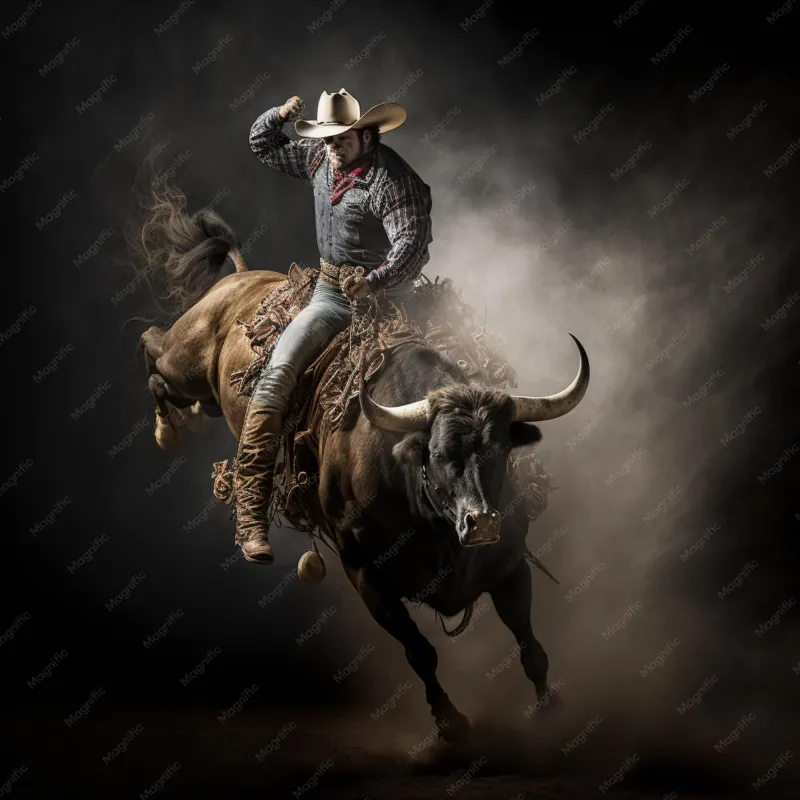
Photo: rodeo arena dusty cowboy bull riding crowd vintage American West, via img.freepik.com
The bull doesn't care about your career. It doesn't care about your shoulder, your knee, or the fact that you've got three kids back in Amarillo counting on this weekend's purse. The bull has one agenda, and the eight seconds between the gate opening and the horn are the entirety of your negotiation with it.
Rodeo clowns understood this better than anyone. Their job — officially called a bullfighter in modern parlance — was to put themselves between an enraged animal and a fallen rider, using distraction, agility, and a willingness to absorb punishment that bordered on the philosophical. They were the last line of defense in an arena where the nearest hospital was often an hour away and the nearest doctor might be two.
Out of that particular combination of danger and distance, something remarkable happened.
A Drifter With a Gift for Emergencies
He had been moving through the Texas and Oklahoma rodeo circuit since his early twenties, picking up work wherever a traveling show needed someone willing to face down a bull for fifty dollars and a bunk in a shared trailer. He wasn't a formally trained anything. His education had ended somewhere around the eighth grade, and his medical knowledge at the start of his rodeo career amounted to what most ranch kids knew: how to clean a cut, how to splint a broken arm well enough to get someone to a doctor, and how to recognize when a man was hurt badly enough to stop moving him.
But rodeo was a relentless teacher.
In a circuit that moved from town to town across the rural Southwest, serious injuries were not occasional — they were scheduled. Bull riders hit the ground wrong. Shoulders dislocated. Knees bent directions knees were not designed to bend. Concussions happened so regularly that they barely registered as events worth noting, which was itself a catastrophic misunderstanding that he would eventually begin to challenge.
With no doctor on site at most small-circuit events, he became the de facto first responder. Not by choice, exactly. By geography.
Learning by Doing, Over and Over
The first time he dealt with a dislocated shoulder, he did what anyone would do: he panicked slightly, then improvised. He had seen it done once, vaguely, by a ranch foreman years earlier. He tried to replicate the technique, failed, tried again, and eventually got the joint back into place well enough that the rider walked off under his own power.
He kept notes. Not in any formal way — he wasn't that kind of person. But he remembered. He catalogued what had worked and what had made things worse, storing the information the way a craftsman stores the memory of a good cut or a bad weld. Over months and then years, he built a practical library of injury management that no school was teaching because no school had thought to look where he was looking.
Joint trauma was his specialty, born entirely of repetition. He developed an intuitive understanding of the difference between a sprain and a tear, between a concussion that needed rest and one that needed immediate evacuation. He learned to assess spinal injuries with a caution that was, for its era, remarkably sophisticated — he had seen what happened when someone moved a man with a back injury too quickly, and he never forgot it.
He also started doing something almost no one in sports was doing in that era: taking head injuries seriously.
The Concussion Problem Nobody Was Talking About
In mid-century American athletics, the cultural attitude toward concussions was roughly equivalent to the attitude toward a bloody nose. You got your bell rung, you walked it off, you got back on the bull. Toughness was the only recognized treatment protocol.
He had watched too many riders deteriorate over the course of a season — becoming slower, less coordinated, quicker to anger, harder to reach — to accept that framework. He didn't have the neurological vocabulary to explain what he was observing. He just knew that something was happening to these men that walking it off wasn't fixing.
He started pulling riders from competition after significant head impacts. Not always successfully — the culture pushed back hard, and riders who needed the money weren't interested in a clown's medical opinions. But he kept records, informal and imprecise as they were, and over time those records told a story that matched, almost uncannily, what sports neurologists would spend the following decades trying to prove.
He was right about the mechanism before the mechanism had a name.
When the Professionals Started Paying Attention
The moment his work crossed over from rodeo lore into mainstream sports medicine was, like most important transitions, quiet and accidental. A team physician from a professional football organization happened to attend a large rodeo event in the late 1950s as a spectator. He watched the clown work a particularly chaotic aftermath — two riders down, one with a clear shoulder injury, one showing signs of head trauma — and was struck by the efficiency and accuracy of what he saw.
He introduced himself. They talked for a long time.
What followed was a slow, informal transfer of knowledge that didn't get documented the way academic discoveries get documented. There were no journal articles with his name on them. There were conversations, demonstrations, and the kind of practical education that happens when one person watches another person work and realizes they're watching something important.
Several of the techniques he had developed — particularly around joint stabilization in the field and the initial assessment of concussive symptoms — found their way into professional sports training rooms over the following decade. The people who adopted them didn't always know where they'd originated. That's how it goes when knowledge travels through informal channels.
Necessity as the Real Medical School
American medicine has a complicated relationship with its unofficial practitioners — the people who developed real knowledge outside the credentialing system, often in circumstances that the credentialing system never anticipated. The history of emergency care, in particular, is full of advances that originated not in teaching hospitals but in wars, disasters, and industries where people got hurt badly and regularly in places too remote for formal help to arrive in time.
The rodeo circuit was one of those places. He was one of those people.
His story is a reminder that expertise doesn't always announce itself with a diploma on the wall. Sometimes it shows up in a barrel in the middle of a dirt arena, wearing face paint and watching a two-thousand-pound animal with the calm attention of someone who has spent years learning exactly what can go wrong and exactly what to do about it.
The bull doesn't care about your credentials. And sometimes, neither does history.
Every revolution in how we treat the human body has started somewhere. His started in the dust.