The Woman Who Learned to Swim at 40 and Refused to Accept That She Was Too Late
The Dare That Changed a Life
Carol Hendricks was sitting poolside at her daughter's community swim meet in 2009, watching children half her age slice through the water with practiced efficiency. She was 40 years old, and she couldn't swim. Not a lap. Not even a full length of the pool.
It wasn't a source of shame—it was just a fact of her life. She'd grown up in Kansas, nowhere near the ocean. Her family didn't have a pool. When she moved to California in her thirties, she'd been too busy with work and raising her daughter to ever take the time. Swimming was something other people did. Not her.
Her daughter's friend's mother—a woman named Jennifer who swam competitively—said something that would echo in Carol's mind for the next decade: "You should learn. It's never too late."
Carol laughed it off. But Jennifer didn't let it go. A few weeks later, she issued an actual dare: "Learn to swim this summer, and I'll take you to the beach in Malibu."
It was meant to be lighthearted. A little challenge between friends. Carol agreed, mostly to end the conversation. She didn't think she'd actually do it.
Starting From Zero
She did. That June, Carol signed up for adult swim lessons at the local YMCA.
The first class was humbling in ways she didn't anticipate. She was the oldest person in the pool by a decade. The instructors had to modify basic exercises because her body didn't have the muscle memory that people who'd swum as children developed naturally. She couldn't float. She couldn't tread water. She panicked when water got in her nose.
But something shifted in those early weeks. Carol stopped thinking of herself as someone learning to swim and started thinking of herself as someone becoming a swimmer. It was a subtle psychological difference, but it mattered. She wasn't trying to check a box. She was building an identity.
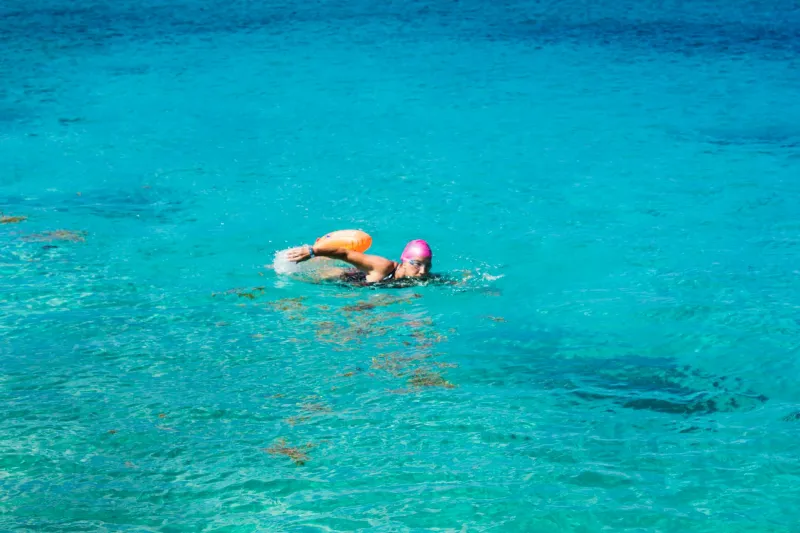
By the end of that summer, she could swim a lap without stopping. It wasn't graceful. It wasn't fast. But it was real. She kept the dare and went to Malibu with Jennifer. She swam in the ocean for the first time in her life.
Most people would have stopped there. Learned to swim, checked the box, moved on. Carol didn't.
The Obsession Begins
Something about the water had gotten under her skin. Maybe it was the meditative quality of it—the way that swimming required her full attention, the way that everything else fell away when she was in the pool. Maybe it was the tangible progress, the way that her body got noticeably stronger and faster with each month of training. Or maybe it was simply that, for the first time in her adult life, she was doing something that had no practical purpose. She wasn't doing it for a job or to support her family. She was doing it purely because she wanted to.
She joined a master's swim team. These are competitive clubs for adult swimmers, and they're more common than most people realize. Carol was still the slowest on her team, but she was surrounded by people who understood what she was trying to do. They'd all come to the pool from different places. Some had swum competitively as kids and returned to it later. Others, like Carol, had picked it up as adults.
Over the next five years, Carol's times improved dramatically. She went from struggling through a single lap to completing 5,000-meter swims. She started entering local open-water races. She competed in triathlons. Her body transformed—not into an athlete's body in the conventional sense, but into something stronger and more capable than she'd ever imagined her body could be.
By 2014, five years after that initial dare, Carol was thinking about something bigger. She'd read about open-water swimmers. About the people who swam across bays and channels and lakes. About the English Channel—one of the most famous open-water swimming challenges in the world.
She mentioned it casually to a friend. The response was immediate: "You're insane."
Maybe. But Carol was 45 years old, and she'd already proven that the age she'd been when she started didn't matter. The question wasn't whether she could do it. The question was whether she was willing to train for it.
The Physics and Psychology of Late Blooming
What Carol didn't know—what most people don't know—is that late-blooming athletes have some genuine advantages over people who start young.
Research on athletic development shows that while early specialization can produce fast results, it often comes with hidden costs. Young athletes who specialize early have higher rates of overuse injuries. They burn out at higher rates. Their bodies, still developing, are pushed into specific movement patterns before they've fully matured.
Adult athletes like Carol start with different constraints but also different advantages. Her nervous system was fully developed. Her brain had decades of experience with how her body moved through the world. She didn't have the muscle memory of childhood swimming to unlearn—she was building from scratch, but with the neurological sophistication of an adult.
More importantly, adult athletes often have what researchers call "intrinsic motivation." They're not doing it because a parent signed them up. They're not doing it because they have to. They're doing it because, on some fundamental level, they want to. That matters more than most people realize. Motivation is often the difference between mediocre effort and the kind of relentless training that produces real results.
Carol had that in abundance.
The Training Years
From 2014 to 2019, Carol's life revolved around the water. She trained six days a week. She swam in the ocean off California, in lakes, in pools. She studied the English Channel crossing—the distance (just over 21 miles), the currents, the water temperature (around 60 degrees Fahrenheit, even in summer), the unpredictable weather.
Most people who successfully cross the English Channel are between 25 and 50 years old. Carol would be 50 when she attempted it. Not impossibly old, but not young either. The cold water would be harder on her body. Recovery would take longer. The margin for error was thinner.
But Carol had something that younger swimmers often didn't: she had trained her mind as much as her body. She'd spent five years building confidence. She'd completed open-water swims that pushed her to her limits. She understood pain, fatigue, and the voice in her head that says quit. She'd learned how to move past that voice.
She also had a coach—a man named David who specialized in English Channel training. He'd worked with dozens of swimmers, and he recognized something in Carol immediately: she would not give up. Not because she was naturally gifted. But because she'd already spent a decade proving to herself that she could do hard things.
August 2019
Carol launched from Shakespeare Beach in Dover, England, on a gray morning with choppy water. The English Channel is notorious for its unpredictability. The tides shift. The currents are powerful and can push swimmers miles off course. The water is cold enough to cause hypothermia if you stay in too long. The crossing typically takes between 12 and 16 hours of continuous swimming.
Carol had trained for this moment for five years. But training and doing are different things. In the water, alone, with nothing but the sound of her own breathing and the cold pressing in from all sides, she had to trust everything she'd learned.
She swam for 14 hours and 23 minutes. She touched the beach in France as the sun was setting. She became one of the oldest American women to successfully complete a solo English Channel crossing.
When she emerged from the water, the first thing she did was call Jennifer—the woman who'd issued that dare 10 years earlier.
The Uncomfortable Question
Carol's story is inspiring, but it's also uncomfortable. Because it raises a question that American sports culture doesn't really want to ask: What if our obsession with early specialization is actually limiting human potential?
In the U.S., we've built an entire system around identifying athletic talent in childhood and developing it through specialized training. Kids are sorted into travel teams, elite academies, and competitive programs while they're still in elementary school. The assumption is that this is the most efficient way to develop champions.
But what if that system is also filtering out potential? What if there are thousands of Carols out there—people who could become exceptional athletes, given the chance, but who are told by age 12 or 13 that they're "not athletic" because they didn't start early enough?
The research on adult athletic development is still emerging, but what we know is encouraging: adult-onset athletes can achieve remarkable things. They don't have the speed of elite youth athletes, but they often have superior discipline, mental toughness, and intrinsic motivation. They're choosing to be there.
Carol's English Channel crossing was remarkable not because it was fast—it wasn't—but because it was possible. It proved that the timeline we've constructed around athletic potential is more arbitrary than we admit. You don't have to be a swimmer at 8 to be a swimmer at 50. You just have to be willing to start.
What Comes Next
After the English Channel, Carol didn't retire. She completed a few more open-water swims. She coached other adult swimmers at her local pool. She became, in a quiet way, an ambassador for late-blooming athleticism.
People ask her if she has regrets about not learning to swim earlier. She doesn't. "If I'd learned at 10," she says, "I would have been a decent swimmer. Maybe a competitive one. But I wouldn't have learned what I learned by starting at 40. I wouldn't have understood that the person I was at 40 was capable of becoming someone completely different."
That's the real lesson of her story. Not that it's possible to learn to swim at 40 and cross the English Channel at 50. It is, but that's the spectacular part. The deeper lesson is about identity and potential and the stories we tell ourselves about what's possible at different ages.
Carol Hendricks wasn't a natural athlete. She didn't have a head start. She had a dare, a pool, and a decade of relentless commitment. That was enough. For her, it was everything.